
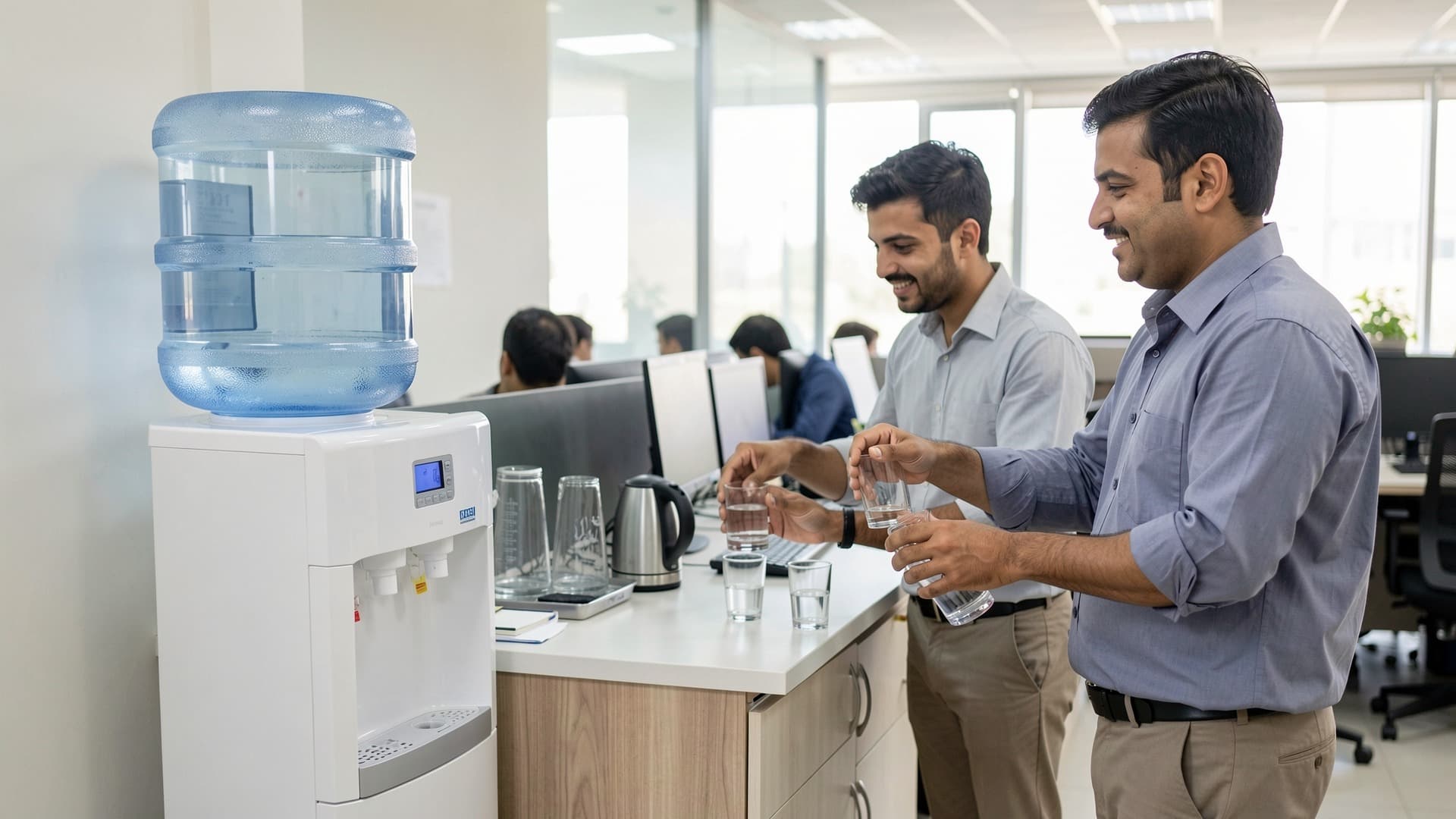
To set up drinking water for an office in Lahore, plan for about 1.5 to 2 litres per person per working day, which is roughly one 19 litre bottle a day for every ten people. Put one dispenser within easy reach of every 25 to 30 people, keep a day or two of full bottles in reserve, give one person the job of looking after it, and choose a supplier who delivers during your working hours and sends one clear invoice. The rest of this guide shows the working behind each of those numbers.
How much water does an office actually use?
People drink less at their desk than they do across a whole day at home, but an office adds things a household does not: tea and coffee for everyone, several times a day, and visitors who are offered water the moment they sit down. Put together, 1.5 to 2 litres per person per working day is a sound planning figure for drinking, tea and guests.
A 19 litre bottle holds 18.9 litres. So ten people use about one bottle a day. From there the arithmetic is simple:
- 10 people: about 15 to 20 litres a day, which is 1 bottle a day.
- 25 people: about 38 to 50 litres a day, which is 2 to 3 bottles a day.
- 50 people: about 75 to 100 litres a day, which is 4 to 5 bottles a day.
- 100 people: about 150 to 200 litres a day, which is 8 to 11 bottles a day.
Multiply the daily figure by the number of days your office is open in a week to get your weekly order. An office of 25 that works six days uses roughly 12 to 16 bottles a week; the same office on a five-day week uses 10 to 13.
What pushes the number up
- Summer. From May to September people simply drink more, and anyone arriving from outside drinks a lot more. Plan for the top of the range, and a little beyond it in the hottest weeks.
- Tea culture. An office where tea is made four or five times a day uses noticeably more water than one with a vending machine.
- Visitors. A showroom, a clinic, a consultancy or a training centre serves water to people who are not on the payroll. Count them.
- Field staff. Riders, drivers and sales teams who come and go fill their own bottles when they are in. They use more than a desk worker.
- Long hours and shifts. A team that works twelve hours, or in two shifts, needs water for every hour the office is occupied.
Measure it for two weeks
The best figure is your own. For the first two weeks, write down the date every time a bottle is changed. Count the bottles, divide by the working days, and you have your real daily use. Order to that, plus a small reserve, and review it when the season changes or the team grows.
How many dispensers, and where?
People drink water that is close. If the dispenser is at the far end of another floor, they drink less, or they drink whatever is nearer. As a starting point, plan one dispenser for every 25 to 30 people, and at least one on every floor.
- Put it where people already pass: near the pantry, the entrance to the work area, or the corridor between teams.
- Keep it out of direct sunlight and away from heat, such as a sunny window or the back of a fridge. Sunlight on a water bottle encourages algae.
- Keep it away from the washroom door, the bin area and anywhere chemicals are stored.
- Give it a power socket of its own if it heats or cools, and space around the back for air.
- Leave room beside it for the next full bottle and for the empty one, so neither ends up in a walkway.
- Add a second dispenser in or near the reception if you receive visitors.
How many bottles to keep in reserve
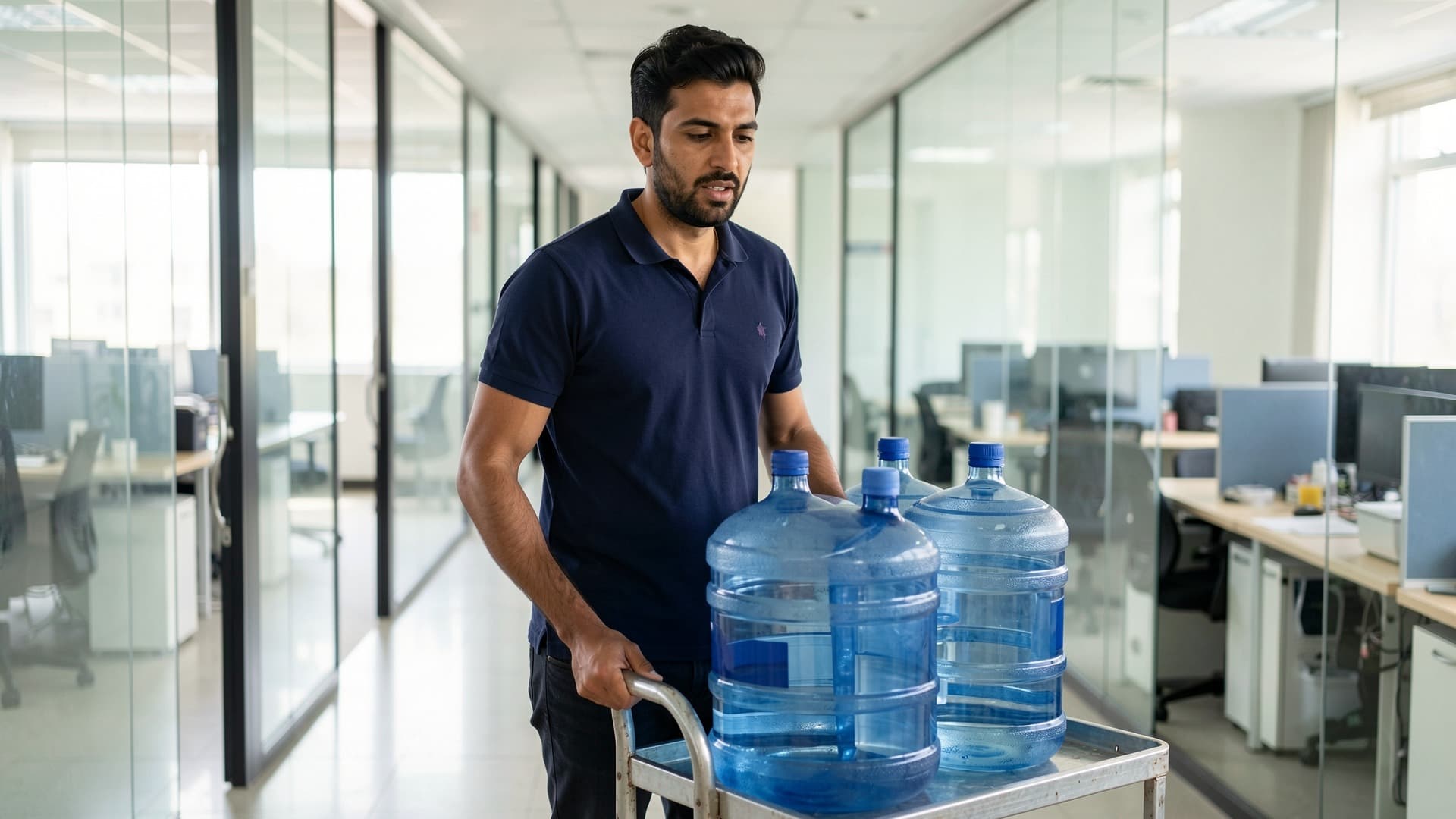
Running out is the failure everyone remembers. Keep at least one to two days of water in reserve beyond what is on the dispensers. For an office of 25, that is three to five full bottles in the store at the start of each day. The reserve is what covers a hot afternoon, an unexpected group of visitors or a delivery that comes later than usual.
Store full bottles upright, indoors, off a dusty floor and away from sunlight, paint, fuel and cleaning chemicals. Use the oldest bottle first. Keep empties in one place with their caps on, ready for collection.
How often should water be delivered?
Delivery frequency follows two things: how much you use and how much you can store. A small office with room for six bottles can take one delivery a week. An office of 100 that uses ten bottles a day cannot store a week of water and will want delivery several times a week.
- Up to 10 people: once a week is usually enough.
- 10 to 30 people: two deliveries a week keeps the store small and the water fresh.
- 30 to 100 people: three or more deliveries a week, or daily for the largest offices.
Fix the delivery days, and make sure they fall in your working hours. A delivery that arrives when the office is locked is a missed delivery. If your office closes on Saturday or Sunday, say so when you set up the schedule.
Meeting rooms and guests
A dispenser serves the team. It does not serve a client in a meeting room. For meetings, visitors, training sessions and events, small sealed bottles are the better answer: one per seat, opened by the person who drinks it. Keep a few packs of 500 ml bottles in the store for this, and a few 1.5 litre bottles for long meetings where a shared bottle on the table is enough.

Keeping the dispenser clean
A sealed bottle of clean water can be spoiled in the last half metre. The dispenser is the part of the system the supplier does not control, and in most offices it is nobody's job. Make it somebody's.
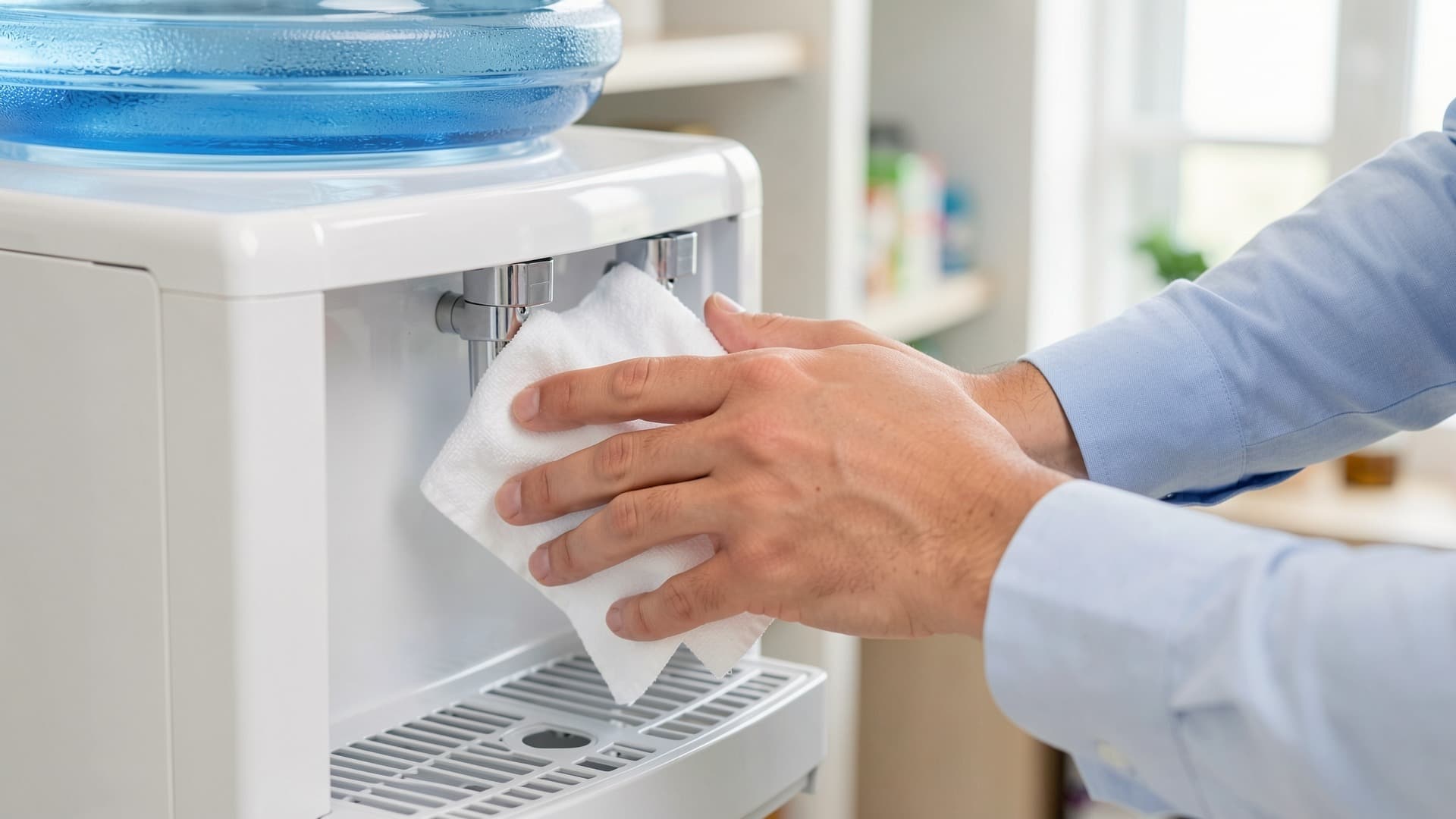
- Every bottle change: wipe the neck and cap of the new bottle with a clean cloth before lifting it on, and wash your hands first.
- Every day: wipe the taps and empty and rinse the drip tray. Standing water in the tray is where smells start.
- Every week: wipe down the whole outside of the dispenser, including the top where the bottle sits.
- Every few weeks: clean the inside reservoir, following the dispenser maker's instructions, and rinse it thoroughly before the next bottle goes on.
- Always: use cups and glasses, never mouths or bottle rims, at the taps.
Give one person the job
Offices run out of water when everyone assumes someone else has ordered it. Name one person, usually in administration, and a deputy for when they are away. Their job is small: check the store each morning, change or arrange the change of bottles, keep the dispenser clean, receive the delivery, hand back the empties and check the invoice. Write the supplier's number where both of them can find it.
What it costs, and how to compare suppliers
Compare the whole monthly cost, not the price of one refill. There are three parts: the refill price multiplied by the bottles you use, any delivery charge on each visit, and the deposit on the bottles you hold. An office holds more bottles than a home, on the dispensers, in the store and as empties, so ask clearly how the deposit works and what you return to get it back.
A plan built for your office is usually cheaper and simpler than ordering bottle by bottle: the quantity and the days are agreed once, and the invoice is predictable. Ask whether the plan can change when your headcount does.
Questions to ask a water supplier for your office
- What is your Punjab Food Authority licence number, and which food-safety certificate does your plant hold?
- Do you deliver to our area, and on which days?
- Between what hours do you deliver, and do those fit our office hours?
- Can the number of bottles change from week to week?
- How does the bottle deposit work for the number of bottles an office holds?
- How do we pay, and do we get an invoice that shows bottles delivered and empties returned?
- Who do we call if a delivery is missed, and how quickly is it put right?
- Can you also supply small bottles for meetings and events?
The right supplier for an office is the one who can tell you, before the first delivery, which days, what hours, how many bottles and what the invoice will look like.
A setup checklist
- Headcount counted, including regular visitors and field staff.
- Daily use estimated at 1.5 to 2 litres per person.
- Number of dispensers decided, with a spot and a socket for each.
- A storage place chosen for full bottles and empties, indoors and out of the sun.
- Reserve set at one to two days of water.
- Delivery days fixed inside working hours.
- One person, and a deputy, made responsible.
- A cleaning routine written down and put up next to the dispenser.
- Small bottles ordered for meeting rooms.
- Use reviewed after two weeks and again when summer starts.
How Aabdar supplies offices in Lahore
- 19 litre bottles for dispensers, and 500 ml, 1.5 litre and 5 litre bottles for meeting rooms and events.
- Weekly and monthly delivery plans, and custom plans for offices whose needs do not fit a standard one.
- Deliveries between 9 AM and 6 PM, on the delivery days of your plan.
- Delivery to 12 areas of Lahore, including DHA, Gulberg, Johar Town, Model Town and Bahria Town.
- Payment by bank transfer or cash on delivery, with an invoice for every order and plan.
- Water bottled at our own plant on Raiwind Road, Ali Town, which holds a Punjab Food Authority licence, ISO 22000:2018 and Halal certification.
The bottom line
Office water is a small system with four parts: enough bottles, dispensers where people are, a clean routine, and a delivery that arrives while someone is there to receive it. Work out your number from your headcount, check it against two weeks of real use, give one person the job, and choose a supplier who commits to days and hours. After that it should be something nobody in the office has to think about.
Frequently asked questions
- How much drinking water does an office need per employee?
- Plan for about 1.5 to 2 litres per person per working day, covering drinking, tea and visitors. In a Lahore summer, plan for the top of that range or slightly more.
- How many 19 litre bottles does an office of 25 people need?
- About 2 to 3 bottles a day, which is roughly 10 to 13 bottles in a five-day week or 12 to 16 in a six-day week.
- How many water dispensers does an office need?
- As a starting point, one dispenser for every 25 to 30 people, with at least one on every floor and one near reception if you receive visitors.
- How often should water be delivered to an office?
- Once a week for up to about 10 people, twice a week for 10 to 30, and three or more times a week for larger offices. It depends on how much you use and how many bottles you can store.
- How often should an office water dispenser be cleaned?
- Wipe the taps and empty the drip tray every day, wipe the outside every week, and clean the inside reservoir every few weeks following the maker's instructions.
- What water should be served in meetings?
- Small sealed bottles, one per seat, are better than a shared dispenser for clients and visitors. 500 ml bottles suit most meetings; 1.5 litre bottles suit long ones.
- Does Aabdar deliver water to offices in Lahore?
- Yes. Aabdar delivers 19 litre bottles and smaller bottles to offices in 12 areas of Lahore, between 9 AM and 6 PM, on weekly, monthly or custom plans.